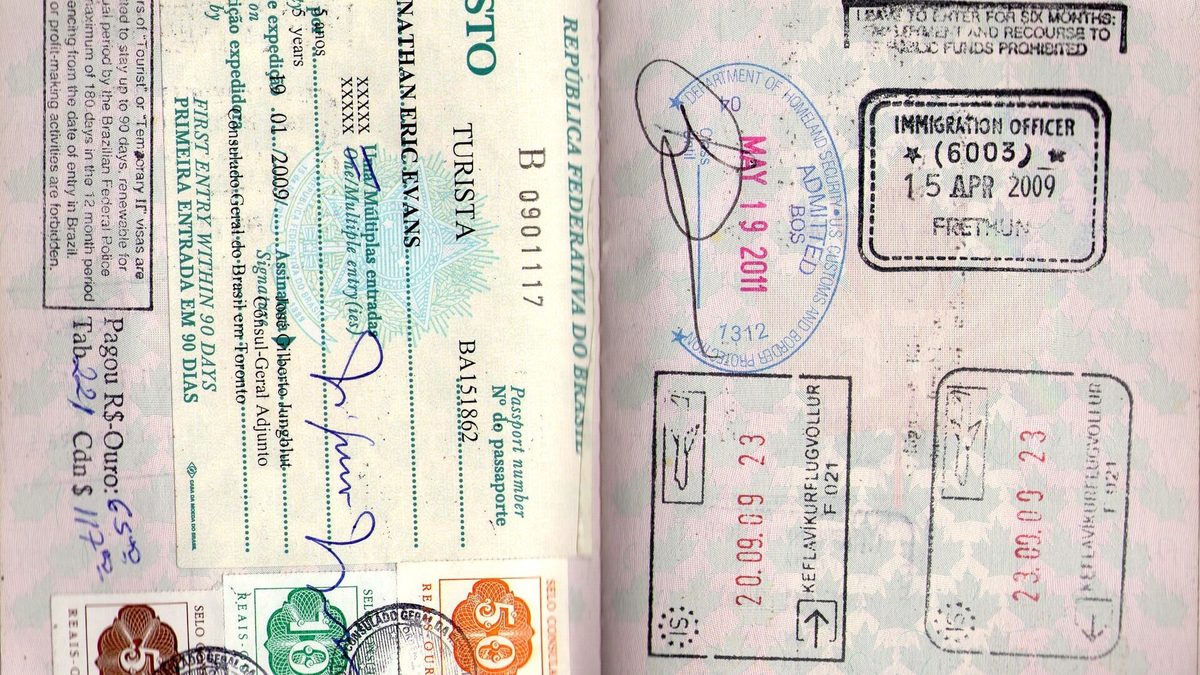
The flight lands at Larnaca a little after midnight. By noon the next day you are standing in a queue with a passport, an offer letter and a phone that has no working number — and the first office you visit asks for a document that a second office issues, which in turn wants a Cypriot address you do not yet have. That loop is what catches most Bangladeshi students in Cyprus, and it has nothing to do with how strong your file was at the embassy.
After arriving in Cyprus, a Bangladeshi student must register in the Aliens' Register and lodge a temporary residence permit application — the card students informally call the Pink Slip — within days, not weeks. The file needs medical tests done in Cyprus, one year of local health insurance, proof of tuition payment and a Cypriot address. Open the bank account early, and register your SIM in person with your own passport.
What is the Cyprus "Pink Slip", and is it the same as a student residence permit?
They are not the same thing, and confusing them costs students time. The Pink Slip is the everyday nickname for the temporary residence permit issued to non-EU nationals who stay in the Republic of Cyprus beyond ninety days, and it is most often discussed in the visitor category — retirees and self-funded residents who must show large annual income from abroad and a big bank balance. As a student you apply in the student category instead, through the Civil Registry and Migration Department (CRMD), and your university's international office normally prepares the pack with you.
What students actually receive is a residence permit tied to the Aliens' Register, usually accompanied by an Alien Registration Certificate (ARC) with a personal ARC number. That number is the one every counter will ask for afterwards — the bank, the mobile shop, the clinic. It is worth learning the difference before you land, because Bangladeshi students who search for "Pink Slip Cyprus" online land on pages written for retirees, panic at the income figures quoted there, and arrive believing they need €24,000 a year in proven foreign income. They do not.
One more piece of geography that matters: the Republic of Cyprus is an EU member state but, as of our checks in 2026, still outside the Schengen area. Your Cyprus residence permit is not a Schengen residence card, and it does not by itself let you travel freely into Schengen countries.
How soon after landing in Cyprus must you register?
Fast. The rule stated by the Migration Department and repeated by Cypriot universities is that a third-country national must register in the Aliens' Register and apply for the temporary residence permit within seven days of arrival, and universities commonly ask their new students to hand in the "after arrival" documents within seven to ten days. Treat seven days as your deadline and build the week around it.
Where you go depends on where you live. The CRMD's own published instructions state that applications are submitted online through the department's platform at eas.crmd.moi.gov.cy, or in person at the central offices of the Civil Registry and Migration Department if you live in the Nicosia District, and at the District Units of the Aliens and Immigration Service of the Police for every other district — so a student in Limassol, Larnaca or Paphos does not travel to Nicosia. Even where the application starts online, an in-person visit follows: the department takes your photograph, fingerprints and signature.
Every document you submit must be in Greek or English, or come with a certified translation into one of those two languages — that includes Bangladeshi documents. And any false statement made in the application or in a supporting document is an offence punishable by fine or imprisonment. Both lines appear verbatim in the CRMD's published instructions.
What documents does the residence permit file actually need?
The core of the file is proof that you are a genuine full-time student who is paid up, insured, medically screened and housed. Universities publish slightly different lists because each institution's international office knows what its district office asks for, so use your own university's checklist as the master copy and the table below as your planning sheet.
| Item | What it proves | Status |
|---|---|---|
| Passport + entry stamp page | Legal entry and date of arrival | Standard |
| Original entry permit | You travelled on a student entry permit | Standard |
| Tuition payment proof | Enrolment is real and funded | Standard |
| Health insurance, 1 year | Inpatient, outpatient and repatriation cover | University-stated |
| Medical tests | Public-health screening in Cyprus | University-stated |
| Bank confirmation | Funds for living costs | University-stated |
| Address proof | Where you actually live | Standard |
The item students underestimate is the last one. A rental contract in your own name, with your own address, is the hinge that the bank and the permit file both turn on — and if you are sharing a flat that someone else signed for, you need to sort out a written arrangement in your name early rather than in week three.

Which medical tests do you need after arriving in Cyprus?
Cypriot universities publish a consistent list: hepatitis B (HBV), hepatitis C (HCV), a syphilis test (VDRL), an HIV test, and a chest X-ray screening for tuberculosis, with results stamped and signed by the doctor. The important detail for Bangladeshi students is that these are normally repeated in Cyprus after arrival, even if you were tested in Dhaka before you flew. Do not treat a Bangladeshi test report as a substitute unless your university's international office confirms in writing that it will be accepted.
Budget a few days for this. Results take time to come back, the insurance certificate usually has to be bought before or alongside the tests, and the permit file cannot be lodged until both are in hand — which is exactly why a student who spends the first week apartment-hunting instead of screening ends up outside the seven-day window.
Ask your university's international office for its insurance provider list before you fly. Cypriot institutions routinely help students buy a compliant one-year policy, and the group arrangement is normally cheaper and — more importantly — already written in the wording the Migration Department expects. A cheaper policy bought online that omits repatriation cover can send your whole file back.
How do you open a bank account in Cyprus as a Bangladeshi student?
Plan on the bank being stricter than you expect and start it in week one. Bank of Cyprus's own new-customer application asks you to attach a copy of your ID or passport, proof of residential address, and a copy of your Alien Registration Certificate — so the bank account and the residence permit are locked together: the permit gives you the ARC, and the ARC unlocks the account. The bank also states plainly that if you do not have an original passport or identity card, you cannot open the account through its mobile app.
Now the detail almost nothing written for Bangladeshi students mentions. The same Bank of Cyprus application has an upload slot labelled "Clean Criminal Record Document if single name on passport". A meaningful number of Bangladeshi passports carry a single-name entry, and a student in that position will be asked for a police clearance certificate that takes weeks to obtain from home. If your passport shows one name only, order your police clearance in Bangladesh before you fly and carry the attested copy with you.
Expect a branch visit too. Web and app applications generally have to be completed in person so the bank can see your original documents and activate the card, which means an appointment, a queue, and a wait for the debit card to arrive by post. Nobody in Cyprus will pay a landlord or a university instalment out of an account that has not been activated.
What are the SIM card rules in Cyprus, and can you register online?
Cyprus ended anonymous prepaid SIMs. Under the Law on the Identification of Holders and/or Users of SIM (or eSIM) Cards for Prepaid Mobile Telephony Services, Law No. 63(I) of 2024, as amended, every prepaid number must be registered to an identified person, and operators enforce it: unregistered numbers were disconnected after the registration deadline, which the House of Representatives extended by one month to 10 December 2025.
For a Bangladeshi student the practical rules are these. Non-EU citizens are identified with a passport. Non-EU citizens who do not have a passport are identified with an immigration permit, or proof of an international-protection application, or a permanent residence permit — and that identification has to be done in a store, not online. Operators do offer a remote digital route where you photograph your passport and then take a live selfie for verification, but it only works if the owner and the user of the line are the same person; if someone else's name is on the line, both people must attend a store together with valid identification. Registration itself is free, and at least one operator states there is no limit on how many prepaid numbers you may register in your name.
A senior meeting you at the airport with a spare SIM is generous, and it is also a trap. That number is registered to them, so the bank's one-time passwords, the university portal, the Migration Department's contact record and your landlord's messages all end up attached to somebody else's identity. Getting the line transferred later means both of you standing at a store counter with documents. Register your own number in your own name in the first week.
What will the first months cost, and how should the money move from Bangladesh?
Permit fees themselves are modest compared with tuition, but they arrive alongside insurance, medical tests, a rent deposit and a flight's worth of exhaustion. The figures below circulate widely and are consistent across sources we checked, but we could not open the Migration Department's own fee page during this research, so treat every number as indicative and confirm at the counter.
| Item | Amount | Approx. BDT | Status |
|---|---|---|---|
| Permit application | €70 | ৳9,900 | Indicative |
| Permit + ARC together | €140 | ৳19,800 | Indicative |
| Renewal | €55 | ৳7,800 | Indicative |
| SIM registration | Free | — | Operator-stated |
| Cash you must declare | €10,000 | ৳14.2 lakh | EU rule |
Converted at €1 = ৳141.69 (open exchange-rate feed, 14 August 2026). Rates move daily.
On carrying money: EU rules require anyone entering or leaving the EU with €10,000 or more in cash — including banknotes, certain bearer instruments and gold — to declare it in writing to customs, and failure to declare, or an incomplete declaration, carries penalties. Cyprus customs guidance goes further and asks travellers to declare at or above the same threshold even when arriving from another EU member state. A first-year student carrying a family's savings in cash is exactly the profile this rule is written for.
The Bangladesh side matters just as much. Under the Bangladesh Bank Guidelines for Foreign Exchange Transactions, an authorised dealer bank releases foreign exchange against the institution's own cost estimate, for a maximum of one academic year at a time, with tuition issued in favour of the institution by transfer or draft rather than handed to the student; every later release needs a fresh estimate and a progress report, and the whole course must be handled through a single AD branch. The guidelines also allow health or medical insurance fees to be remitted where the institution's documents show the insurance is mandatory.
Request a cost estimate letter that lists the compulsory health insurance premium, the medical screening cost and the permit fees as separate line items, not folded into "other expenses". That itemisation is what lets your AD branch in Bangladesh release those amounts cleanly instead of asking you to carry them as cash.
What goes wrong most often — what we see at Eduvisa
Three patterns repeat, and none of them are about weak students.
The first is the address gap. A student stays with a relative or a senior for the first fortnight, has no contract in their own name, and cannot produce address proof for either the bank or the permit file — so both stall together while the seven-day clock runs out.
The second is the insurance mismatch: a policy bought online in Bangladesh, cheaper on paper, that does not carry the inpatient, outpatient and repatriation wording Cypriot authorities look for, discovered only when the file is handed in.
The third is the single-name passport. It surfaces at a bank counter in Nicosia, months after it could have been solved with a police clearance certificate collected in Bangladesh in an afternoon. This is precisely the kind of thing we check before a student flies — not because the rule is secret, but because nobody thinks to look for it until it blocks them.
Your first-week checklist in Cyprus
- Photograph your passport entry stamp page the day you land.
- Contact your university's international office before day two.
- Book the medical tests and buy the compliant one-year insurance.
- Get a written tenancy or accommodation document in your own name.
- Lodge the residence permit application within seven days.
- Open the bank account as soon as your ARC or receipt is in hand.
- Register your own SIM, in person, with your own passport.
Verify before you act. The Migration Department's own student pages and fee schedule could not be opened during this research, so the seven-day registration window, the fee amounts and the medical-test list here come from CRMD instruction documents, Cypriot university guidance and operator pages rather than a single official student page. Confirm every figure with your university's international office and the CRMD or your District Immigration Unit before acting.
Rules differ across the island. Everything above applies to the Republic of Cyprus. The north is not under the Republic's administration, its documents are not EU documents, and nothing on this page applies there. Check which side of the island your institution actually sits on before you accept an offer.
Related guides: Cyprus student visa guide for Bangladeshi students and Cyprus cost of living and monthly budget. If you plan to work alongside your studies, read our Cyprus part-time work rules first.
Official sources referenced: the Cyprus Migration Department and the EU's rules on carrying cash into and out of the EU.
Landing is not the finish line — it is where the paperwork starts
Most consultancies wave goodbye at the airport. We do not. Eduvisa walks Bangladeshi students through the arrival week in Cyprus itself — the permit file, the insurance wording, the bank appointment, the SIM counter — because a visa that lands and a student who settles are two different achievements. Come and talk it through with us before you book the ticket.
Book Free Consultation →